Cosine Similarity as Logits?: A Scalable Knowledge Probe Using Embedding Vectors from Generative Language Models
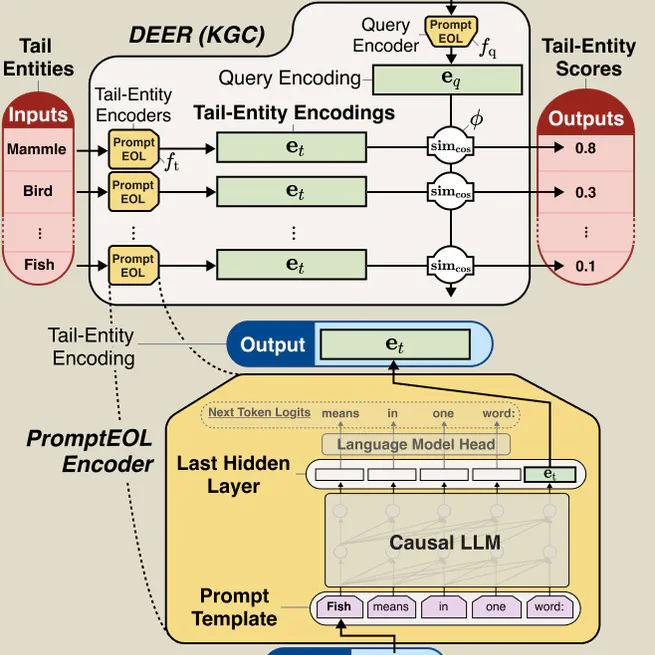
There has been a growing interest in utilizing pre-trained language model (PLM) as a soft knowledge base. Knowledge probers evaluate PLM's ability to fulfil such role using relational knowledge stored in a knowledge graph (KG). However, knowledge probes for generative language models are slow, and do not scale over input size. To this end, we propose a fast and scalable knowledge probe for generative PLMs and demonstrating its ability to probe using KGs that were previously infeasible.
Mar 24, 2026
Cosine Similarity as Logits?: Few-shot Knowledge Graph Completion with Embedding Vectors of a Generative PLM and its Application in Knowledge Probing
The Knowledge graph completion (KGC) task aims to predict missing relations in knowledge graphs (KGs). Recently, text-based KGC approaches have gained attention but they present challenges: encoder-based methods require fine-tuning making it non-ideal when an ideal KG for training cannot be obtained, such as when KG is sparse or predicting new relation-types. Meanwhile, decoder-based methods make prediction by generating tokens, where entity disambiguation becomes a challenge. KGC is also used in knowledge proving, which aims to evaluate the know edge retrieval capability of pre-trained language models (PLMs), but existing probes for generative PLM capable of ranking all multi-token and single-token entities are computationally inefficient. To address these problems, we propose DEER, an encoder-based few-shot KGC, leveraging a generative PLM that achieves a linear inference time complexity. Our experiment shows that DEER outperforms a fine-tuned KGC model in a relationally inductive setting and aligns with an existing knowledge-probing method, positioning it as a possible alternative.
Mar 10, 2025